



⚡ Key Takeaways
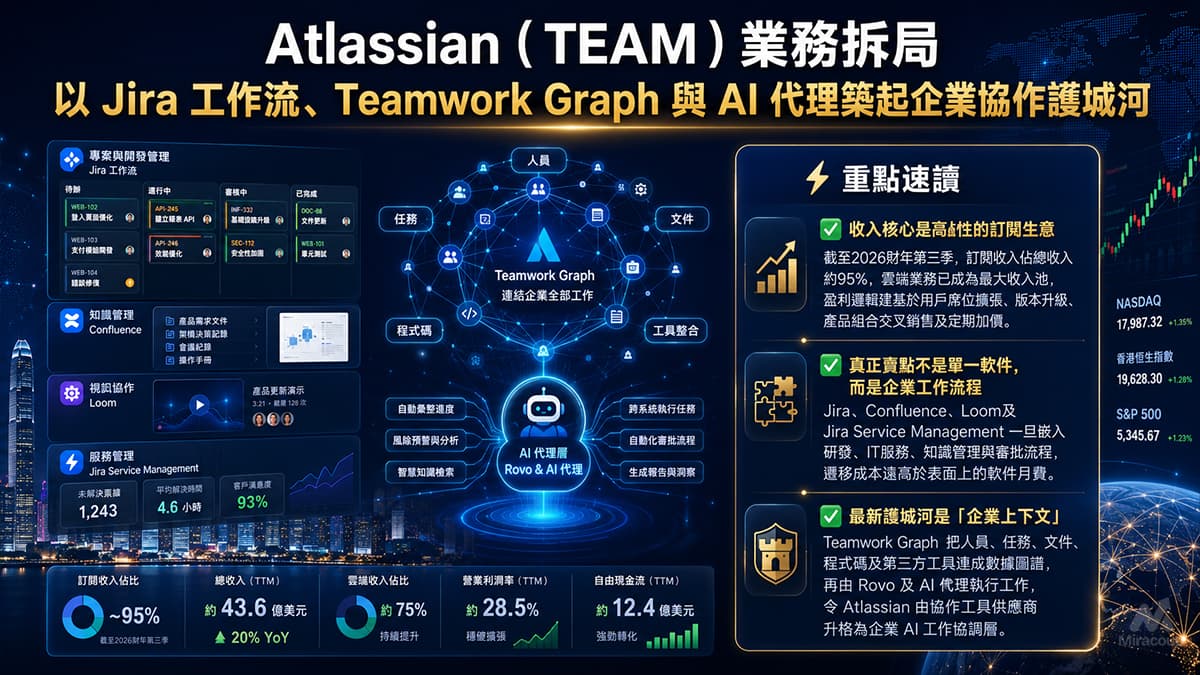
- The core revenue is a highly sticky subscription business: As of Q3 FY2026, subscription revenue accounts for about 95% of total revenue, and the Cloud business has become the largest revenue pool. The profitability logic is built on user seat expansion, version upgrades, cross-selling of product bundles, and regular price increases.
- The real selling point is not a single software, but enterprise workflows: Once Jira, Confluence, Loom, and Jira Service Management are embedded into R&D, IT services, knowledge management, and approval workflows, the switching costs become far higher than the apparent monthly software fees.
- The latest moat is “Enterprise Context”: Teamwork Graph connects people, tasks, documents, code, and third-party tools into a data graph, which is then utilized by Rovo and AI agents to execute work, elevating Atlassian from a collaboration tool provider to an enterprise AI work coordination layer.
1. Deconstructing the Business Model
Founded in Sydney in 2002, Atlassian initially started with Jira serving software development teams, and subsequently expanded its footprint from software development to IT operations, knowledge management, project collaboration, and general business teams through Confluence, Bitbucket, Trello, Jira Service Management, and Loom. Its corporate DNA has always been very clear: first use low-friction products to penetrate small teams, then expand upwards along the organizational structure, ultimately becoming a cross-departmental work system.
How exactly does Atlassian generate revenue? The answer is not one-off traditional software licensing, but a recurring subscription model priced per user, product version, and feature bundle. As of Q3 FY2026, the company’s quarterly revenue reached $1.787 billion, up 32% year-over-year; of which, subscription revenue was approximately $1.699 billion, accounting for 95% of total revenue. By deployment method, Cloud revenue was $1.132 billion, Data Center revenue was $561 million, and Marketplace and other revenues were about $93.8 million.
This model can be broken down into a three-layer revenue engine:
- Layer 1: Core Product Subscriptions. Jira, Confluence, and Jira Service Management remain the primary revenue pillars. Customers pay based on seats and Standard, Premium, or Enterprise tiers. Contracts are typically billed monthly or annually, providing highly predictable deferred revenue.
- Layer 2: Land-and-Expand. Small teams can try and buy online autonomously; once the product becomes the standard for daily work, the company then adds users to the same customer account, expands to other departments, upgrades to enterprise versions, or sells Teamwork, Service, Strategy, and Software Collections.
- Layer 3: Ecosystem Monetization. The Atlassian Marketplace allows third-party developers to sell plugins. The company shares in the transaction value while leveraging thousands of extensions to fill vertical needs, making the core platform much harder to rip and replace.
Its underlying economics are particularly noteworthy. In its early years, Atlassian advocated that “software should be bought, not sold,” using free versions, transparent pricing, self-service trials, and online transactions to lower customer acquisition costs. Only after the customer scales up does the enterprise sales team step in to handle larger, more complex contracts. This is a hybrid model shifting from product-led growth (PLG) to “PLG plus enterprise sales.”
Over 90% of Q3 FY2026 revenue came from customer accounts that existed prior to the beginning of the quarter. This reflects that while new customers are important, the true source of compounding is existing customers adding seats, adding products, and accepting price hikes. The company’s gross margin for the same quarter was 85%, and its free cash flow margin reached 31%, indicating that even as cloud hosting and AI inference costs rise, its software revenue still possesses substantial cash conversion capabilities.
Rovo’s commercial strategy is also not rushing to charge per seat. Atlassian is embedding some AI capabilities into Jira, Confluence, Jira Service Management, and Collections to lower the AI adoption barrier first, and then monetizing indirectly by enhancing the value of premium tiers, expanding knowledge worker seats, and driving product bundle upgrades. In other words, at this stage, AI is more of a retention, pricing, and cross-selling tool rather than an isolated revenue island.
2. Deep Dive into Core Moats
Moat 1: High Switching Costs Created by Workflows
Applying Warren Buffett’s moat framework, Atlassian’s deepest barrier is not its brand name, but its switching costs. After an enterprise uses Jira for years, it accumulates not only task records but also custom fields, permission architectures, automation rules, approval workflows, service catalogs, knowledge bases, code links, compliance records, and third-party integrations.
To replace this system, an enterprise cannot simply export data and buy another tool; it must redesign workflows, rebuild plugins, train employees, verify permissions, and bear the risk of project disruption. When Jira expands from a single engineering team to product, legal, finance, human resources, and IT service departments, switching costs rise non-linearly.
Therefore, Atlassian’s pricing power does not stem from a lack of alternatives for customers, but from the fact that the total cost of replacing the system is often far higher than the difference in annual subscription fees. This is the fundamental reason the company can consistently drive subscription revenue growth through seat expansion and price adjustments.
Moat 2: Marketplace, Teamwork Graph, and the Data Flywheel
The second barrier is a composite moat sitting between ecosystem network effects and data advantages. The Marketplace has thousands of third-party applications; developers are willing to build plugins because of the massive customer base, and more plugins in turn increase the platform’s coverage and customer stickiness, forming a two-way flywheel.
Teamwork Graph pushes this barrier a level higher. It organizes the relationships between Jira tasks, Confluence documents, Loom videos, code, employees, project goals, and external tools like Google Drive, Slack, GitHub, and Figma into a unified, permission-controlled enterprise context.
As of May 2026, Atlassian stated that Teamwork Graph contains over 150 billion objects and relationships and can connect to about 100 common applications. The company’s own benchmarks show that adding graph context can improve AI answer accuracy by 44% while reducing token usage by 48%. While these figures are company test results and may not directly apply to every customer, they clearly reflect that the focus of its AI strategy is not building its own Large Language Models (LLMs), but mastering enterprise work data and relationships.
The key to this advantage lies in its cumulative nature: the longer customers use it, the more tools they connect, and the richer the work relationships generated, the more complete the context Rovo and third-party agents can access. Competitors can copy a chat interface, but it is extremely difficult to instantly replicate a process graph an enterprise has accumulated over years.
Moat Level Assessment: Atlassian’s business moat has entered deep waters; the most valuable assets are workflow switching costs and enterprise context, not the AI models themselves. However, it is not impregnable: large comprehensive software vendors can grab budgets through bundle discounts, and the IT service management and project collaboration markets are intensely competitive. Its long-term investment value depends on whether Atlassian can translate AI usage into higher renewal rates, more seats, and stronger profitability, rather than just piling on free features.
3. Corporate Turning Points and Future Catalysts
Three Evolutions of Corporate DNA
- Tool Stage: Penetrated software development teams with Jira and Confluence, disrupting the traditional enterprise software model relying on massive sales forces via low prices, self-service purchasing, and word-of-mouth growth.
- Platform Stage: Through the Marketplace and acquisitions of assets like Trello, Opsgenie, Mindville, and Loom, expanded the product from engineering collaboration to work management, IT services, asset management, and asynchronous communication.
- System Stage: With Cloud Platform, Collections, Rovo, and Teamwork Graph, integrated standalone products into a “System of Work” connecting technical teams, business teams, and AI agents.
The Most Important Strategic Inflection Point: Sunsetting Server Products and Betting on Cloud
The most decisive step in Atlassian’s history was the 2020 decision to terminate Server products, officially ending support on February 15, 2024. This decision caused short-term customer pushback and migration discount pressures, but it cleared out the version fragmentation of on-premise software. This allowed the company to continuously release features, centralize security governance, integrate cross-product data, and deploy Rovo and Teamwork Graph on a unified Cloud platform.
Without this Cloud transition, Atlassian might still be an excellent developer tool company, but it would struggle to become an enterprise AI work system. In other words, the Server sunset is superficially a change in deployment model, but fundamentally a total reset of its business model, product architecture, and valuation narrative.
Three Major Catalysts for the Next 1-2 Years
- Accelerated Migration of Data Center Customers to Cloud. Atlassian has stopped selling Data Center subscriptions to new customers. The deadline for existing customers to add licenses and expand is March 30, 2028, and the products will reach end-of-life on March 28, 2029. The next two years will be the most intensive window for migration activities, benefiting Cloud ARR, long-term contracts, and Collections penetration. However, investors also need to monitor migration discounts, customer churn, and hosting costs.
- Rovo Upgrading from a Search Assistant to an Agent Coordination Layer. Atlassian now allows teams to assign tasks within Jira to Rovo or MCP-supported third-party agents, retaining permissions, audit logs, and work history. If Jira successfully becomes the control plane where humans and AI agents jointly take orders, collaborate, and deliver, Atlassian’s serviceable user base will expand from developers to knowledge workers across the entire enterprise.
- Collections Driving Enterprise Cross-Selling. Service Collection’s ARR has surpassed $1 billion, growing at over 30% YoY; Teamwork Collection is also benefiting from Jira seat expansion and AI feature adoption. Coupled with the acquisitions of engineering performance analytics platform DX and The Browser Company, Atlassian is extending from back-office work management to engineering decision-making and browser work portals, possessing the potential to reopen valuation upside.
Another easily overlooked catalyst is operating leverage. The company restructured its headcount and resource allocation in 2026, generating large short-term restructuring expenses, but the direction is to concentrate resources on enterprise customers, AI, and the System of Work. If revenue maintains double-digit growth while sales and R&D expenses gradually normalize, the market’s focus may shift from “high growth but high share-based compensation” to free cash flow and earnings quality, driving a re-rating of its valuation baseline.
4. Frequently Asked Questions (FAQ)
How does Atlassian (TEAM) primarily make money?
Atlassian mainly collects Cloud and Data Center subscription fees through Jira, Confluence, Jira Service Management, Loom, and various Collections. Growth comes from new customers, seat additions, version upgrades, product cross-selling, and price adjustments, while the Marketplace provides a smaller but strategically valuable ecosystem revenue stream.
Will Atlassian’s moat be replaced by Microsoft, ServiceNow, or next-generation AI tools?
A single feature can indeed be replicated or bundled, but Atlassian’s advantage lies in the workflows, plugins, permissions, historical data, and cross-departmental collaboration relationships customers have already established. The real risk is not that a specific AI chat tool is better, but whether competitors can offer the same level of workflow integration, enterprise governance, and context at a lower price.
What impact does the sunsetting of Data Center have on TEAM’s stock and business?
The positive impact is that after customers migrate to the Cloud, the company can secure more consistent recurring revenue, improve product cross-selling efficiency, and allow customers to utilize Rovo and full Cloud AI features. The negative impact is that some highly regulated or on-premise-reliant customers might delay migration, demand discounts, or even switch to other platforms. Therefore, the Data Center exit is both a strong catalyst and a massive execution test.
Disclaimer: This article is for the exploration of business logic and corporate research only, and does not constitute investment advice of any kind.