



⚡ Key Takeaways
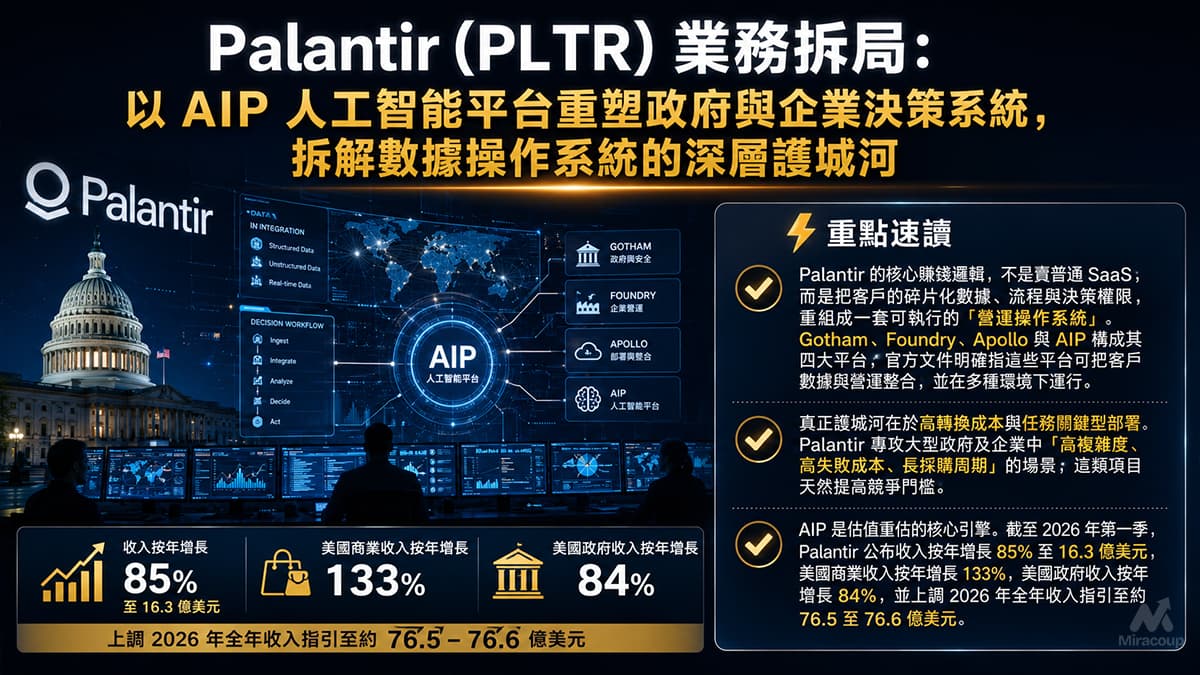
- Palantir’s core monetization logic is not selling standard SaaS, but restructuring customers’ fragmented data, workflows, and decision-making authorities into an actionable “operating system.” Gotham, Foundry, Apollo, and AIP make up its four major platforms. Official documents explicitly state that these platforms can integrate customer data with operations and run across diverse environments.
- The true moat lies in high switching costs and mission-critical deployments. Palantir specializes in scenarios for large governments and enterprises characterized by “high complexity, high cost of failure, and long procurement cycles,” which naturally raises the barrier to entry.
- AIP is the core engine for its valuation rerating. As of Q1 2026, Palantir reported an 85% year-over-year revenue growth to $1.63 billion, with US commercial revenue up 133% YoY and US government revenue up 84% YoY, while raising its full-year 2026 revenue guidance to approximately $7.65 to $7.66 billion.
1. Business Model Deconstruction
On the surface, Palantir (PLTR) is a data analytics and AI software company, but through a buy-side research lens, it is closer to a “mission-critical decision infrastructure provider.” Its products do not simply put data in the cloud, nor are they traditional BI dashboards. Instead, they transform data—previously scattered across disparate systems, access rights, and departments within government agencies, military units, and large enterprises—into an actionable, auditable decision layer executable by AI agents.
The company’s revenue primarily comes from two main customer segments: government and commercial. The government sector centers on defense, intelligence, public safety, and administrative systems, while the commercial sector covers high-complexity industries like manufacturing, energy, aviation, finance, healthcare, and logistics. In 2024, 55% of Palantir’s revenue came from government customers and 45% from commercial customers. In the same year, the company had 711 customers, with its platforms deployed across roughly 90 industries.
Its underlying product architecture can be divided into four layers: Gotham serves government and security scenarios, helping users identify patterns and threats in massive datasets; Foundry serves enterprise operations, integrating business data from various sources into an enterprise-grade operating system; Apollo handles continuous delivery across cross-cloud, on-premise, and highly secure environments; and AIP combines LLMs with internal enterprise data, access rights, workflows, and human approval mechanisms, allowing AI to not just answer questions, but participate in actual operational decision-making.
Palantir’s profitability model doesn’t rely on low prices, massive user bases, or ad traffic, but on high average contract values, deep deployments, long-term contracts, and use-case expansion. Once the platform enters a customer’s core workflows, revenue growth typically comes from three directions: first, onboarding more departments; second, integrating more workflows into the platform; third, using AIP to automate judgments, scheduling, forecasting, and executions previously handled manually. In other words, the quality of Palantir’s revenue depends on its ability to upgrade from a “single-project vendor” to a “customer operational nerve center.”
This also explains why the AIP Bootcamp has become a growth inflection point in recent years. Palantir officially stated that the AIP Bootcamp allows customers to build real-world use cases from scratch in 5 days; its annual report also noted that introducing Bootcamps into the customer acquisition process helps clients experience the platform with their own scenarios in a matter of days. This sales model compresses the traditional enterprise software process of “sign the contract first, deploy later, see results in six months” into “show business results first, then drive procurement decisions,” which is particularly explosive in the US commercial market.
2. Deep Dive into Core Moats
Analyzing through Warren Buffett’s moat framework, Palantir’s most critical barrier is not brand awareness, but a composite moat of switching costs and intangible assets.
Layer 1 Moat: Extremely High Switching Costs. Palantir usually doesn’t enter peripheral applications; it penetrates core workflows like defense missions, supply chain scheduling, capacity management, risk monitoring, drug discovery, public health, and safety decisions. Once Gotham or Foundry becomes a customer’s “operating layer,” changing vendors doesn’t just mean swapping software; it means rebuilding data pipelines, access governance, audit workflows, user habits, decision rules, and AI workflows. This deep embedding makes Palantir more like an enterprise or government data backbone than an easily replaceable SaaS tool.
Layer 2 Moat: Intangible Assets Accumulated in Mission-Critical Scenarios. Palantir has long served defense, intelligence, and large enterprise scenarios. What it has accumulated is not merely code, but the engineering know-how to turn data into actionable decisions in highly classified, highly compliant, and highly chaotic environments. This know-how is hard for startups to replicate solely through model capabilities, nor can it be quickly acquired by major cloud vendors relying on sales channels.
The company’s annual report clearly states that its target customers are mostly large government and commercial organizations involving high installation costs, high failure risks, complex data environments, and long sales cycles. Management also believes that the larger, more complex, and more technically demanding the problem, the higher Palantir’s chances of winning. This statement reveals its corporate DNA: Palantir was not born for “easily standardized” workflows, but for scenarios that “cannot fail, cannot outsource judgment, and cannot tolerate black boxes.”
However, a moat doesn’t mean the valuation carries no downside risk. After the Q1 2026 earnings, despite strong revenue growth, the market experienced a pullback due to lofty valuations, commercial revenue slightly missing some expectations, and intensifying AI competition. Therefore, PLTR’s long-term investment horizon should look beyond revenue growth to three indicators: whether AIP continues to drive commercial customer expansion, whether government contracts maintain high visibility, and whether free cash flow and profit margins can sustain its high-valuation narrative.
3. Corporate Inflection Point and Future Catalysts
The most critical strategic inflection point in Palantir’s history is its transition from a “government intelligence and defense data tool” to an “enterprise AI operating system.” Founded in 2003, its early core positioning was highly aligned with national security, counter-terrorism, and intelligence analysis. Gotham built Palantir’s foundation of trust on the government side, while Foundry pushed the same data integration and operational logic into the commercial world. With the launch of AIP in 2023, Palantir’s narrative upgraded again: it no longer just helps clients see data clearly, but allows AI to participate in decision-making within a controlled, auditable, and authorized architecture.
The power of this pivot began to reflect in its numbers between 2025 and 2026. In Q1 2026, total revenue grew 85% YoY, and US revenue grew 104% YoY; US commercial revenue surged 133% YoY to $595 million, and US government revenue grew 84% YoY to $687 million. For capital markets, this signals that Palantir is transitioning from a “government project-driven” model to a “government and commercial dual-engine” model.
Over the next 1 to 2 years, there are three most important catalysts.
First, AIP Commercial Penetration. If Bootcamps can continue converting trial scenarios into large contracts, Palantir’s commercial revenue growth may continue to outpace traditional enterprise software peers. This will directly support the market’s valuation premium for its “AI enterprise operating system.”
Second, Defense AI and Modern Warfare Demand. Reuters reported that Palantir’s raised 2026 revenue forecast is tied to strong US government demand and increased usage of the Maven AI battlefield software; the Maven system is also reportedly on track to become an official US Department of Defense program. In a high-pressure geopolitical environment, AI military decision-making, intelligence fusion, unmanned system coordination, and supply chain security are all likely to become long-cycle demands for Palantir’s government business.
Third, Platformization and Industry Operating Systems. Palantir’s annual report mentions that the company is developing industry operating systems and has established partnerships in aviation, insurance, healthcare, automotive, security risk management, and government sectors. If these deployments expand from single customers to industry-level standards, Palantir’s revenue model will upgrade from “tackling large clients one by one” to “replicating via industry templates,” and its valuation logic will shift closer to platform infrastructure rather than project-based software.
However, risks cannot be underestimated either. Palantir’s own annual report lists competitors including large software companies, system integrators, defense contractors, and emerging AI platforms. If competing products gain an advantage in features, performance, or price, demand could be pressured. Additionally, AI model errors, data bias, regulatory, privacy, and reputational risks are all core variables in AIP’s expansion process.
4. Frequently Asked Questions (FAQ)
Is Palantir’s (PLTR) business model SaaS?
Strictly speaking, Palantir is not a typical low-touch, highly standardized SaaS. It is closer to an “enterprise and government-grade operating system provider,” integrating customer data, workflows, permissions, and AI decision-making via Gotham, Foundry, Apollo, and AIP. Its revenue quality comes from deep deployments, long-term contracts, and the expansion of internal use cases, rather than lightweight SaaS that simply charges per seat.
How does Palantir AIP make money for the company?
AIP’s value lies in connecting large language models (LLMs) to real enterprise data and workflows, while adding permission management, auditing, human approval, and security controls. This allows AI to generate tangible operational value in scenarios like production scheduling, risk monitoring, supply chains, customer service, defense intelligence, and resource allocation. As customers expand from single use cases to multiple departments, AIP unlocks opportunities for larger contracts and higher customer stickiness.
What is PLTR’s biggest moat?
PLTR’s biggest moat is the combination of “high switching costs” and “mission-critical intangible assets.” Once Palantir’s platform enters the core workflows of a government or large enterprise, replacing the system involves data reconstruction, process redesign, compliance audits, employee training, and the reconfiguration of decision-making authority. This complexity means that even if competitors possess powerful AI models, they may not be able to quickly replace its position at the operational level.
Disclaimer: This article is for the exploration of business logic and corporate research only, and does not constitute investment advice of any kind.